
As we have previously stated in the circulars published on our website, as well as in our contributions to seminars held during the drafting process, the General Municipal Urban Plan (PGOM) represents a decisive step forward. However, the full renewal of Marbella’s urban planning framework requires the completion and approval of the Urban Planning Plan (POU), an essential instrument for addressing the municipality’s existing urban planning situation and making progress towards restoring legal certainty.
1. Marbella’s PGOM and POU: A Historic Opportunity to Resolve Its Urban Planning Problems
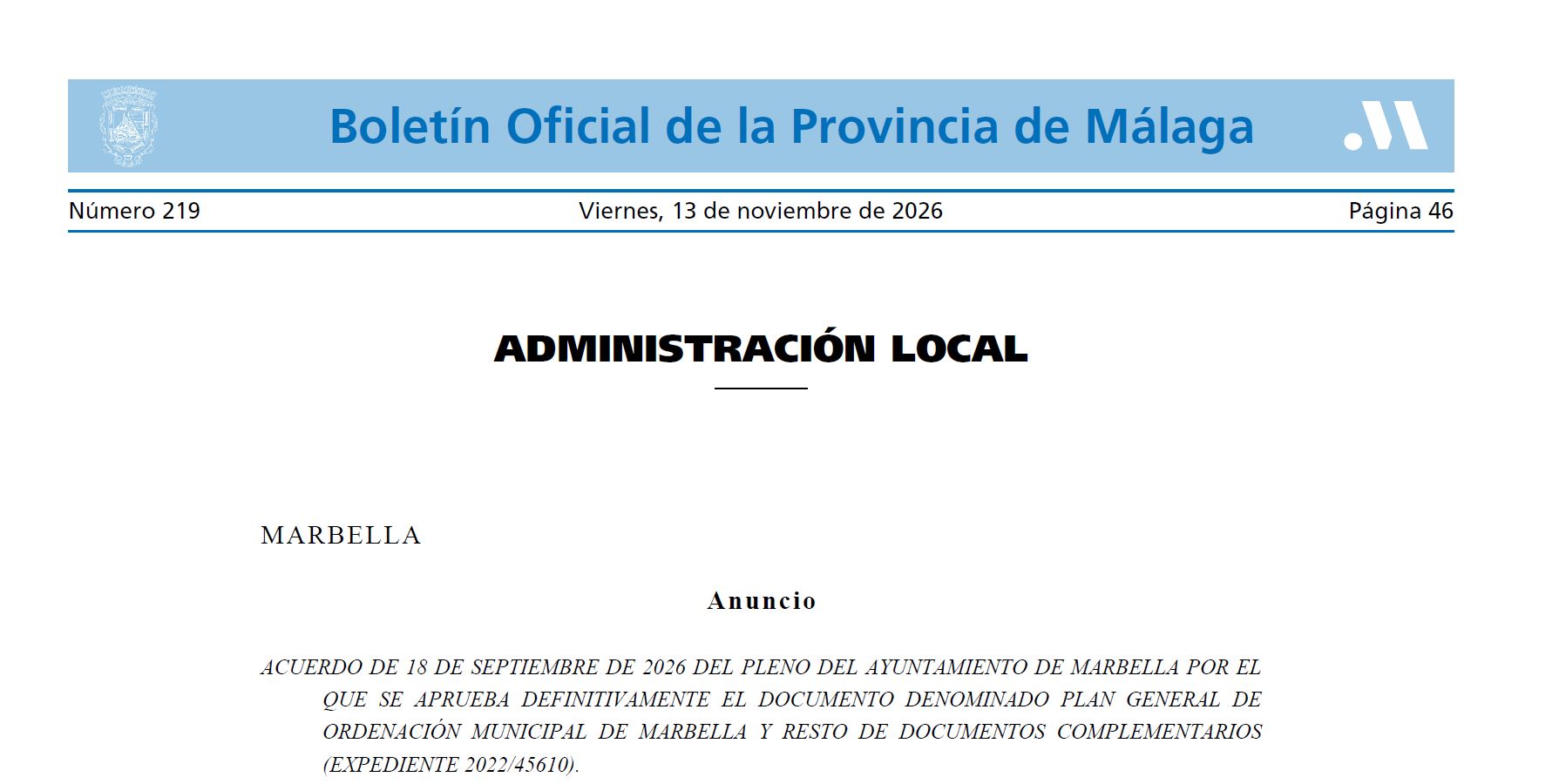
On 14 November 2026, Marbella’s new General Municipal Planning Plan (PGOM) came into force, following its final approval by the Municipal Council at its plenary session on 18 September 2026 and its publication in the Official Gazette of the Province of Málaga (BOPMA) on 13 November.
The approval of this planning instrument undoubtedly represents an event of extraordinary importance for Marbella, a municipality that has endured an exceptional urban planning situation for decades, characterised by the proliferation of irregular buildings, the judicial annulment of planning instruments and the resulting legal uncertainty.
To understand the significance of this new planning framework, it is necessary to recall that Marbella has experienced an urban planning situation that is difficult to compare with that of other municipalities.
Between 1995 and 2005, numerous property developments were carried out under municipal planning licences which, in many cases, were subsequently declared null and void by the courts because they contravened the urban planning regulations established under the 1986 General Plan, which was in force at the time.
This gave rise to a particularly complex situation involving approximately 18,000 residential units and numerous operating commercial establishments affected by urban planning irregularities, despite forming part of the city’s consolidated urban fabric.
The General Urban Development Plan (PGOU) approved in 2010 attempted to address this problem by incorporating numerous irregular buildings into the urban planning framework, establishing certain compensation mechanisms and requirements for compliance with urban planning obligations.
However, judgments of the Spanish Supreme Court dated 27 and 28 October 2015 declared the 2010 PGOU null and void, resulting in the reinstatement of the 1986 General Plan.
Marbella was therefore once again subject to a planning framework approved in 1986, originally designed for a city substantially different from the one that actually existed.
For years, this situation has affected urban development, real estate activity and the possibility of providing legal solutions to numerous long-established situations.
The entry into force of the PGOM therefore represents a fundamental step forward. Nevertheless, its approval alone cannot be regarded as having resolved the municipality’s longstanding urban planning problems.
The next step, and probably the most significant in addressing the situation of existing irregular buildings, is the approval of the Urban Planning Plan (POU).
2. From Defining the City’s Development Model (PGOM) to Planning for the Marbella That Actually Exists (POU)
Law 7/2021 of 1 December, on the Promotion of Territorial Sustainability in Andalusia (LISTA), replaces the traditional municipal general planning system with two distinct planning instruments.
The General Municipal Planning Plan (PGOM), regulated by Article 63 of LISTA, is intended to establish the municipality’s overall planning and development model.
The Urban Planning Plan (POU), regulated by Article 66, is intended to establish the detailed planning regulations applicable to urban land, without prejudice to those areas whose detailed planning must be developed through subsequent instruments.
This distinction is particularly important in Marbella.
While the PGOM defines the territorial and urban development model that should guide the municipality’s future, the POU must establish the detailed planning framework for the existing city, determining the planning conditions applicable to its various areas.
Indeed, the PGOM itself provides for a transitional regime under which certain urbanisation and building regulations contained in the 1986 PGOU will remain applicable until the POU is approved.
This demonstrates that approval of the PGOM alone does not complete the renewal of the municipality’s urban planning framework.
Beyond this consideration, however, the true significance of the POU lies in its ability to address Marbella’s unique urban planning challenges.
Marbella is not merely a municipality that needs to plan for future growth. It must also address, from both an urban planning and legal perspective, the consequences of developments carried out over several decades, many of which now form part of established neighbourhoods, residential developments and consolidated urban areas.
The objective, therefore, is to establish a planning framework for the city as it actually exists, rather than exclusively for the city envisaged under the former 1986 PGOU.
3. Incorporating Irregular Buildings into the Planning Framework: A Possibility Expressly Recognised by LISTA
One of the most significant developments introduced by Andalusian urban planning legislation for a municipality with Marbella’s particular characteristics is the express recognition of the possibility of incorporating irregular buildings into the urban planning framework.
Article 176 of LISTA establishes that local authorities may, when preparing urban planning instruments or through their amendment or revision, incorporate irregular buildings that are compatible with their territorial and urban development model.
This provision is particularly significant in Marbella, where approximately 18,000 residential units and numerous operating commercial establishments are affected, for various reasons, by urban planning irregularities, including properties constructed under municipal planning licences that were subsequently annulled.
Article 176 of LISTA, as further developed by Article 416 of its General Regulations, approved by Decree 550/2022, makes such incorporation conditional upon compatibility with the territorial and urban development model, justification on grounds of public interest, and compliance with the corresponding urban planning obligations and requirements.
The new legal framework therefore provides a means of addressing certain situations involving urban planning irregularities.
4. Approval of the POU Must Become an Urban Planning Priority for Marbella
The preliminary POU document was approved on 18 January 2024 by resolution of the Local Government Board and was submitted to public consultation for a period of 30 working days commencing on 22 January.
The purpose of this consultation was to gather public opinion and encourage participation in the drafting process, particularly regarding the problems to be addressed, the need for and appropriateness of preparing the planning instrument, and its proposed objectives and alternatives.
The Scoping Document for the Strategic Environmental Study has also been issued by the Regional Delegation for the Environment in Málaga. Marbella Town Council published this document on its new urban planning portal on 15 October 2025.
At present, we understand that the drafting team should be at a very advanced stage in preparing the Strategic Environmental Study and the preliminary urban planning document for the POU, together with the necessary sector-specific reports, with a view to obtaining initial approval.
We believe that completing the approval process for the POU is essential, not only because it is necessary to complete the planning system established under LISTA, but also because it represents a particularly important opportunity to address the consequences of urban planning irregularities accumulated over several decades.
The objective should be to establish a planning instrument capable of identifying irregular buildings and areas, assessing their compatibility with the new urban development model and, where appropriate, determining the conditions necessary for their incorporation into the urban planning framework.
This must be approached from a comprehensive perspective, taking into account Marbella’s physical and social reality, ensuring compliance with urban planning obligations and safeguarding the public interest.
Marbella cannot continue planning its future while disregarding a significant part of its existing built environment. Equally, it cannot seek to resolve the problems of the past without respecting the requirements of the legal system.
The real challenge lies in reconciling these two needs.
Legal certainty cannot be restored by ignoring irregular buildings, but rather by addressing their situation through a justified, coherent urban planning framework that fully respects the law.
CONCLUSIONS
• The final approval and entry into force of Marbella’s PGOM represents an achievement of considerable significance, particularly in light of the consequences arising from the annulment of the 2010 planning framework and the reinstatement of the 1986 PGOU.
• However, the municipality still faces an essential task: completing the approval of the Urban Planning Plan and making use of the possibilities offered by current Andalusian legislation to incorporate into the planning framework those irregular buildings that are compatible with the new urban development model.
• Such incorporation should not be understood as the blanket legalisation of irregular developments, but rather as a legally recognised possibility that must be exercised through duly reasoned decisions, respecting judicial rulings and grounded in the public interest.
• Marbella’s urban planning future cannot be built by disregarding its past, but rather by addressing it within the law and through a coherent planning vision of the existing city.
• The PGOM has defined the city’s development model. It is now for the POU to establish the detailed planning framework and provide solutions to the urban planning problems that Marbella has faced for decades.
• The approval of the POU and the incorporation of irregular buildings that are legally compatible with the city’s development model are therefore two closely linked and essential objectives in making progress towards restoring legal certainty in Marbella’s urban planning framework.
Marbella, 16 November 2026
